Engineers/Juan de la Cierva
Juan de la Cierva
The Spanish engineer who turned a dangerous instability into a flying machine — one solved problem at a time.
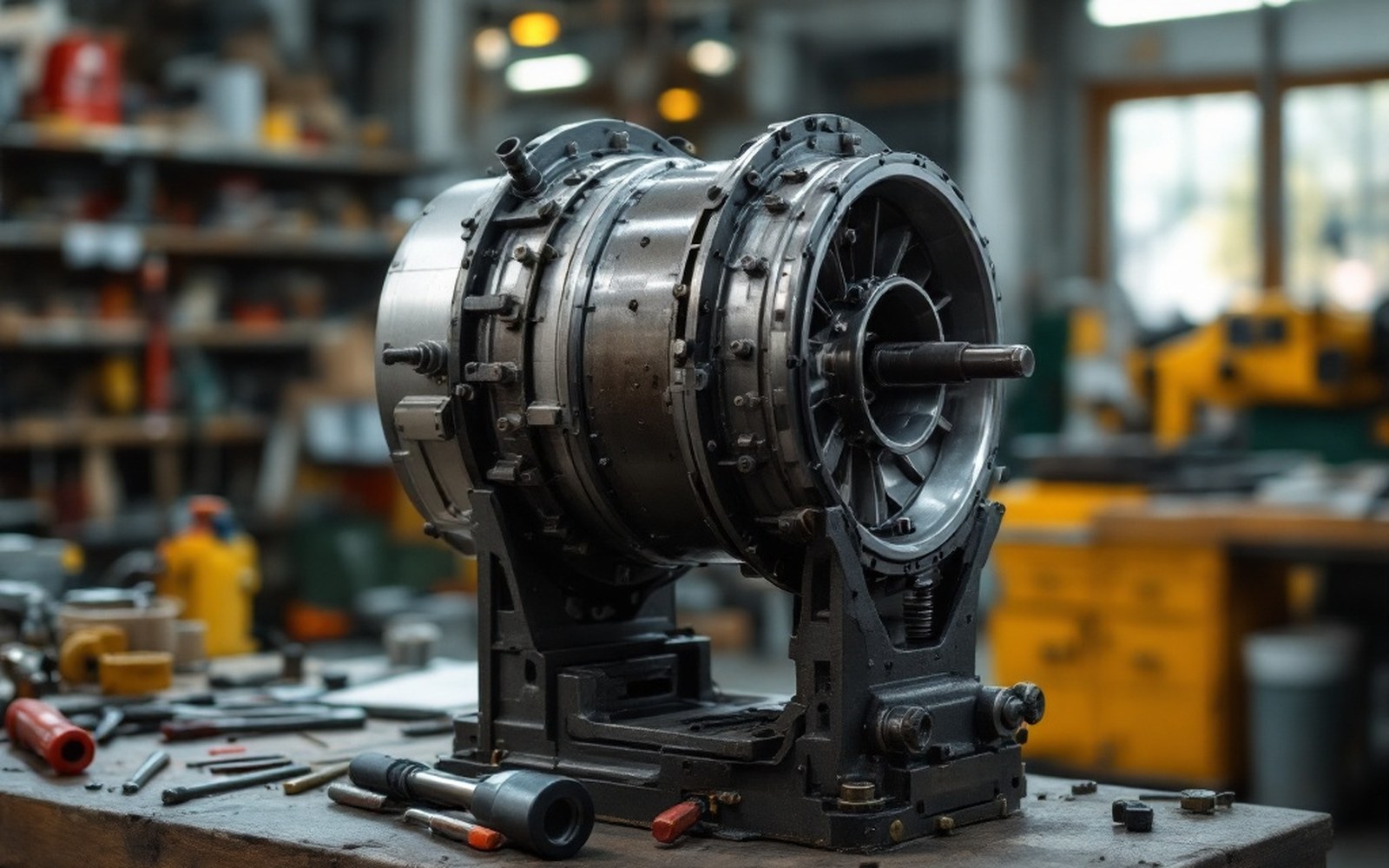
Worked out on the benchHub assemblies were small machined parts; the tolerances were the hard half of the idea.
The problem he started with
Juan de la Cierva was trained as a civil engineer, not an aeronautical one, which may be why he approached the rotor as a structural and geometric problem before it was anything else. Born in Murcia in 1895, he had already co-designed a three-engine biplane — the BCD-1 — before he turned twenty-five. When a prototype bomber he was associated with stalled and crashed in 1919, the question that stayed with him was not about engines or pilots but about what happens to a wing at low speed. He wanted an aircraft that could not stall. The autogiro — his word, now a generic term — was the answer he spent the next eighteen years refining.
The core idea was simple enough to state: replace the fixed wing with a freely spinning rotor, and let the airflow itself keep it turning as the machine moves forward and descends. That phenomenon, autorotation, meant that even with the engine cut, the rotor would continue to generate lift. The machine would descend steeply but never plunge. What Cierva could not have anticipated in 1920 was how many separate engineering crises would have to be resolved before that simple idea would actually fly safely.
Solving it in sequence
The first autogiro, the C.1, flew — briefly and badly — at Getafe in 1920. So did the C.2 and C.3. All three suffered from the same invisible adversary: dissymmetry of lift. On a rotor turning in forward flight, the blade sweeping forward into the oncoming airflow meets far greater relative velocity than the blade retreating away from it. The advancing blade generates more lift, the retreating blade less, and the resulting rolling moment was enough to tip the early machines over before they could gain altitude.
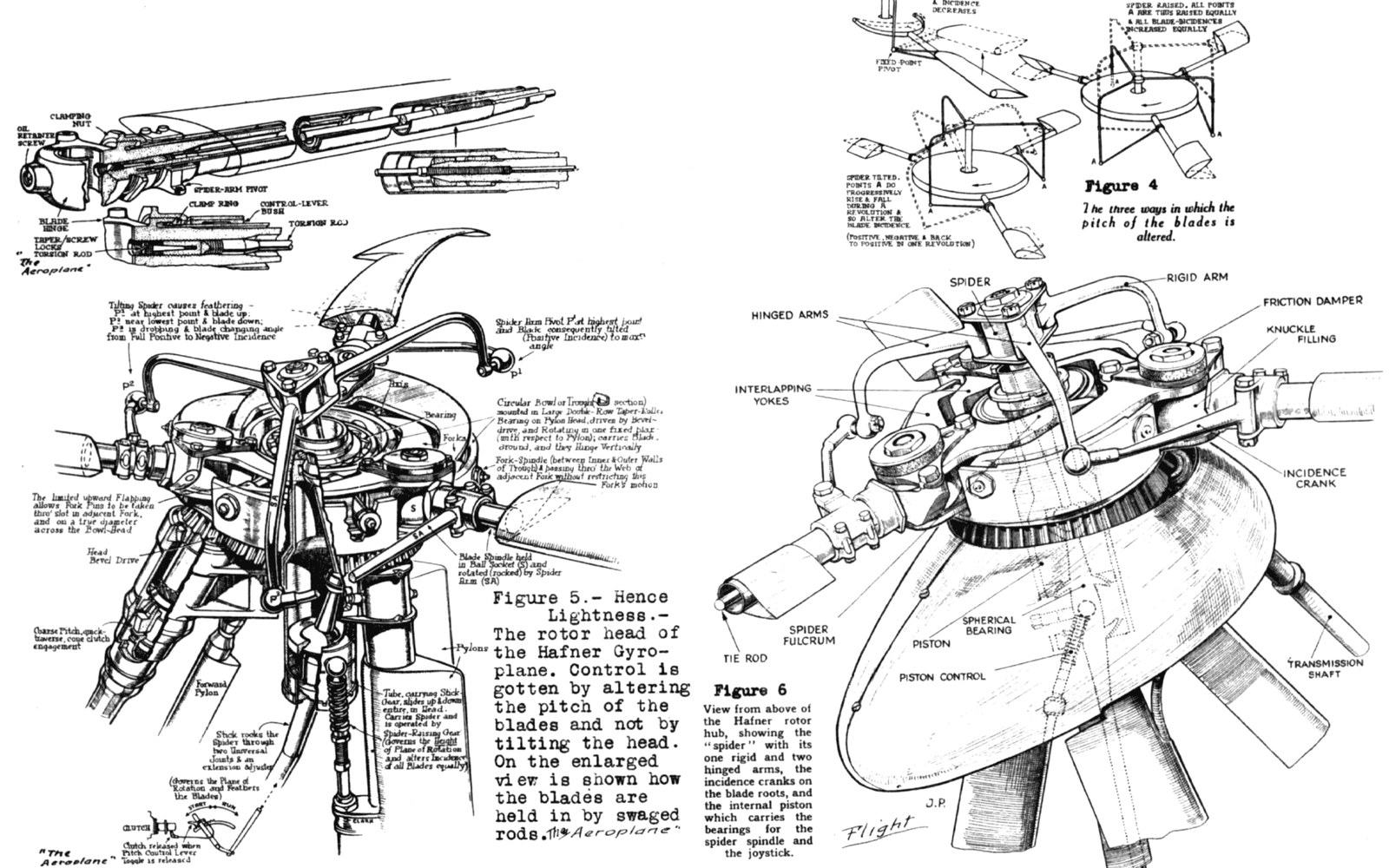
The pinned jointThe hinge sits between blade and hub, and on surviving machines it can still be moved by hand.
Photo: Hafner AR.III rotor head detail NACA-AC-205 · Wikimedia CommonsCierva's response, worked out between 1922 and 1923, was the flapping hinge — a pivoted attachment that allowed each blade to rise and fall freely about a horizontal axis at its root. A blade generating excess lift simply flapped upward; as it did, the geometry of its movement reduced its angle of attack and shed the surplus. A blade generating too little lift flapped downward; as it did, its angle of attack increased and restored the lost lift. In both cases the hinge let the blade find its own equilibrium. The flapping hinge was not a compromise; it was a precise mechanical answer to a precise aerodynamic question, and it is the reason rotorcraft became possible at all.
The C.4, fitted with flapping hinges, flew successfully at Cuatro Vientos in January 1923. It was the first practical rotorcraft flight in history, witnessed by officers from the Spanish Army's aviation branch. Cierva immediately understood that a single flight proved a principle, not a product, and he kept working. The C.5 introduced a drag hinge — another pivot, this one allowing limited blade movement in the plane of rotation — to absorb the oscillating chord-wise loads that the flapping hinge alone could not damp. The C.6 was stable enough to demonstrate before the Royal Aeronautical Society ↗ in London in 1925, which brought British industrial backing and changed the pace of development entirely.
The publication habit
What distinguishes Cierva from many contemporaries is that he published as he went. His papers to learned societies and his patent filings documented not just what worked but why, tracing the aerodynamic reasoning in terms that other engineers could follow and contest. The Royal Aeronautical Society's journal carried several of his contributions through the 1920s and 1930s, and the detailed analysis in those papers meant that when licensed manufacturers in Britain, France and the United States began building his designs, they were working from documented theory, not just copied geometry.
This mattered for another reason. Cierva's later machines tackled direct control — tilting the whole rotor head to steer the aircraft rather than using external control surfaces that were ineffective at low speed — and the reasoning behind that step was sufficiently well documented that it survived him. When he was killed in an airliner crash at Croydon in December 1936, there was enough written work, enough drawings, enough filed patents for the engineering to continue. That continuity was not accidental; it was a professional discipline he had maintained throughout.

Where the argument happenedBoards in rows under high windows: rotor work is geometry before it is anything else.
The machines as argument
Each successive C-type was essentially a published experiment. The C.8 demonstrated the autogiro to American audiences and confirmed transatlantic interest. The C.19 became the first version manufactured in quantity, with a version built under licence in Britain by the Avro company. The C.30, the most refined of the series, achieved something Cierva had sought for years: a rotor that could be spun up on the ground by diverting engine power through a clutch, then released for an almost-vertical climb — jump take-off in its near-final form. The C.30 is the machine most likely to be encountered in a surviving collection; the Museo del Aire at Cuatro Vientos holds examples that allow the rotor head geometry to be examined directly.
The progression from C.1 to C.30 took roughly fifteen years and resolved, in order, dissymmetry of lift, blade flapping, in-plane oscillation, control authority at low speed, and ground handling at the start of a take-off run. Each solution introduced the next problem. The drag hinge, for instance, created a resonance risk — ground resonance, in which the blade oscillation frequency couples destructively with the undercarriage — that later engineers had to address. Cierva identified the phenomenon but did not fully solve it before his death. He left it as a documented open question, which is itself a form of engineering generosity ↗.
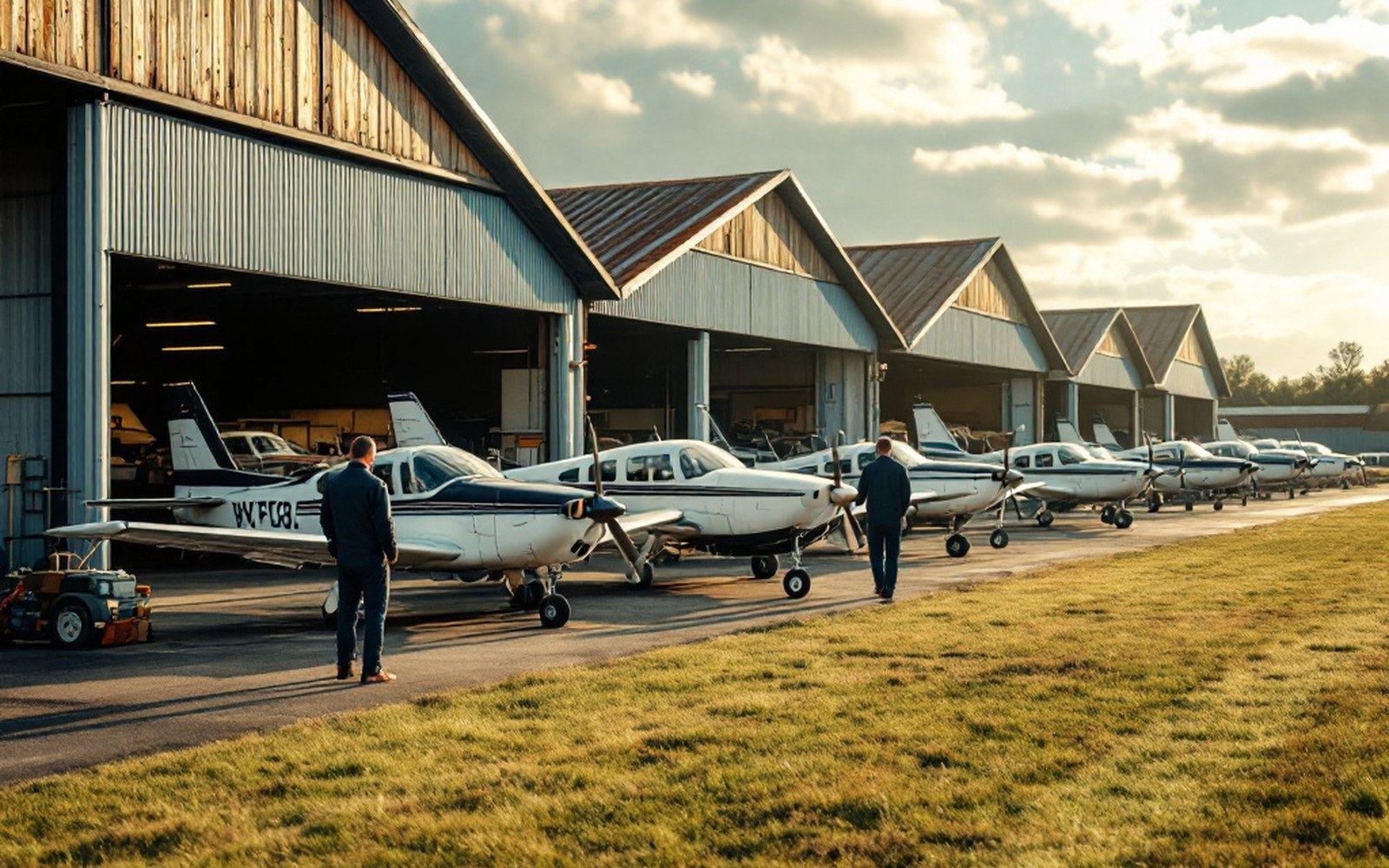
Still in useLow hangars and a wide apron on the southern edge of Madrid, where the first practicable rotorcraft flew.
What he left behind
The practical legacy is obvious: without the flapping hinge and the demonstration that autorotation was controllable, the helicopter would have arrived later and more painfully. The analytical legacy is subtler but equally important. Cierva treated the rotor disc as a system in which every degree of freedom interacted with every other, and he insisted on understanding each interaction before moving to the next machine. That method — iterative, documented, published — is still recognisable in rotorcraft engineering today.