Rotorcraft/Direct control
Direct control
Tilting the whole rotor head rather than working control surfaces in its wake was the step that made the machine properly flyable.
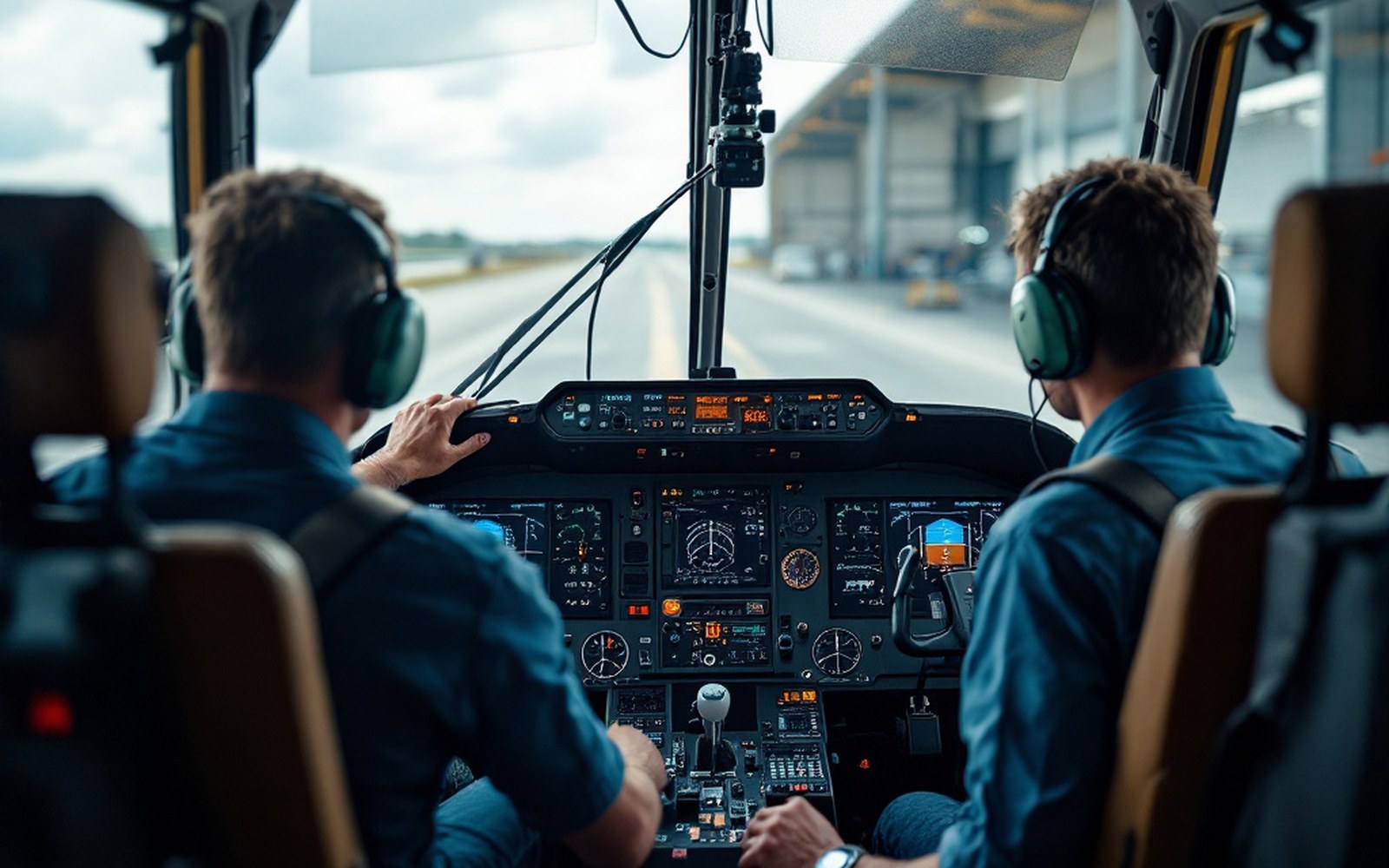
Steering the head itselfControl runs up the mast to the hub rather than out to surfaces sitting in the rotor wake.
How tilting the disc replaced the old wing controls
The earliest autogiros were not flown by the rotor alone. Juan de la Cierva ↗'s initial machines carried orthodox aircraft surfaces — ailerons, elevators, a rudder — to steer and roll the aircraft in the conventional way, with the freewheeling rotor above doing nothing more than providing lift. That arrangement worked, after a fashion, but it brought a chronic problem: at low speeds, when the airflow over those surfaces dropped away, control authority went with it. The machine became sluggish and then unresponsive at precisely the moment a pilot needed it most.
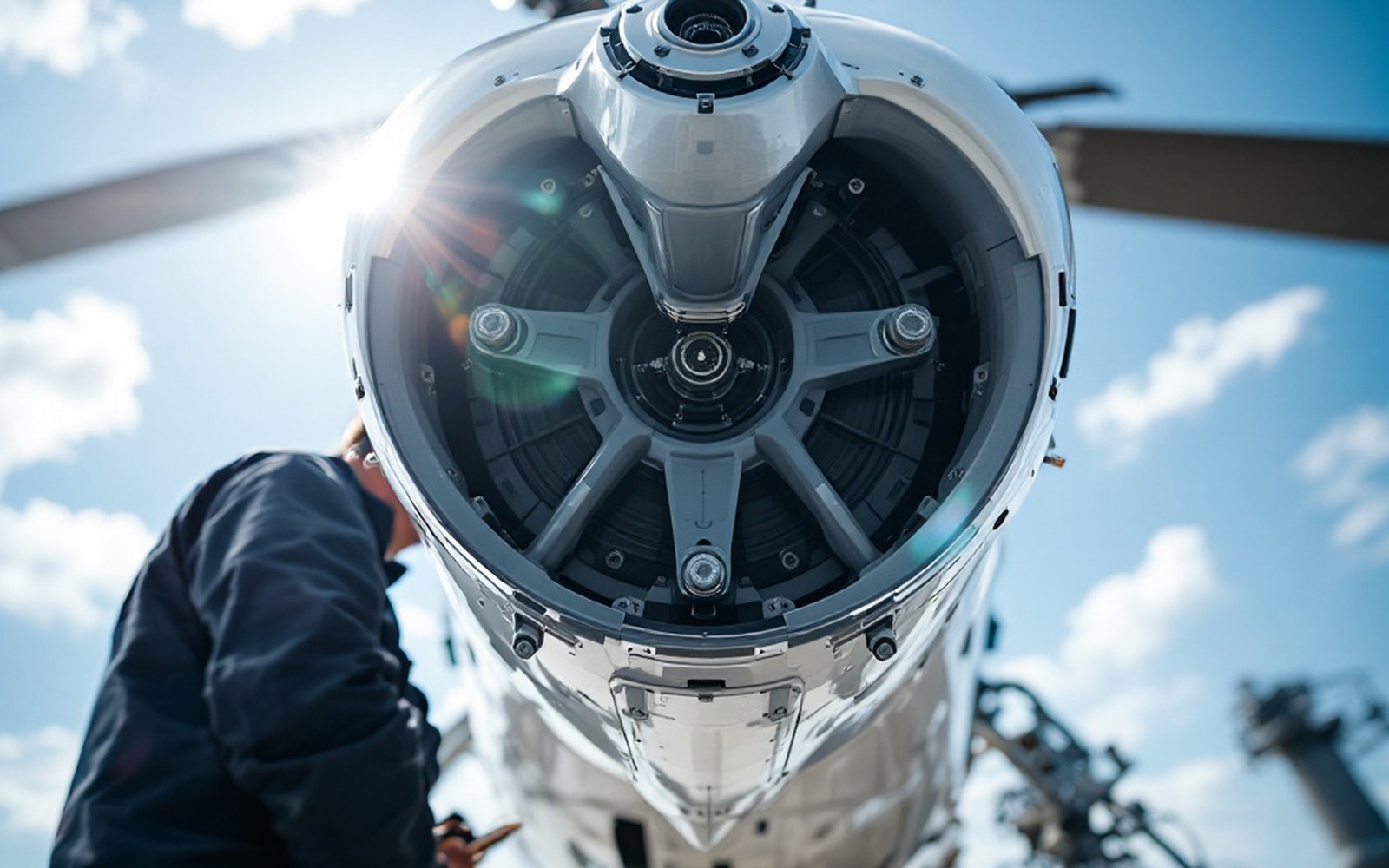
The hinge, in hardwareBlade roots and linkages on a rotor head: the pinned joints are what let each blade rise and fall on its own.
The solution Cierva developed through the late 1920s and into the early 1930s was to abandon the conventional surfaces almost entirely and instead tilt the rotor head itself. If the entire spinning disc could be inclined fore and aft, or side to side, the thrust vector it produced would move with it — pushing the aircraft in whichever direction the disc was pointing. Control was now rooted in the rotor, the one element that kept working regardless of forward speed, and the machine's handling changed fundamentally as a result.
The geometry of tilting thrust
To understand why this mattered, consider what a rotor disc actually does. It generates a column of thrust perpendicular to its own plane. Point the disc straight up and the thrust lifts the machine; tilt it forward and a component of that thrust accelerates the aircraft ahead; tilt it to the left and the aircraft banks left. The pilot's stick, rather than deflecting a hinged surface somewhere downstream, now physically repositioned the entire rotor head. The mechanism connecting stick to head was called direct control — a name that says exactly what it is.
The engineering to make this work was not trivial. The rotor head had to pivot in a universal-joint arrangement so that stick inputs in any direction produced a corresponding tilt, while the rotor continued to spin freely through the entire range of motion. The flapping hinge was already present in earlier Cierva machines to deal with dissymmetry of lift as blades advanced and retreated; direct control required that this hinge arrangement coexist with a new tilting axis at the top of the rotor pylon. Getting both to function without interfering mechanically, and without introducing vibration that would shake the machine apart, took several iterations.
Cierva demonstrated a workable direct-control system on the C.30 series, the design that became the most widely produced autogiro of the period and the one built under licence by CASA in Spain, by Avro in Britain, and by other manufacturers across Europe. The C.30 dispensed with ailerons entirely; roll and pitch were handled through rotor tilt alone, and a conventional rudder remained only for yaw. Pilots who flew it found the response notably more intuitive than earlier types — the Royal Aeronautical Society ↗ documented contemporary accounts of how much easier transition training became once the rotor was doing the steering work.

Flown by the people who drew itEach modification had to be taken up and tried, usually by the designer.
What direct control made possible
The practical consequences ran further than mere handling quality. Because the rotor could generate a lateral or longitudinal force component independently of the airframe's attitude, the autogiro could descend in a controlled fashion onto a chosen point on the ground, descend almost vertically under full authority, and land in spaces that no fixed-wing type could approach. Direct control was what gave the autogiro its short-field reputation in operational use, rather than its autorotation capability alone — both were necessary, but without the ability to steer precisely at near-zero forward speed, the safe descent was still hard to put down in the right place.
Later rotorcraft engineers, working toward the helicopter, would extend the same logic. Cyclic pitch — tilting the disc by varying blade pitch periodically around the azimuth rather than by physically moving the head — accomplishes the same vector shift by a different mechanical route, and understanding dissymmetry of lift was necessary before either approach could be reliably engineered. The direct-control autogiro was the proving ground. The machines that flew it, many of them built or tested at Cuatro Vientos outside Madrid, carried the argument from drawing-board geometry to something a pilot could rely on.